So I'm totally into amateur radio now... I have multiple handhelds, a couple desk radios, multiple antennas, and TWO different call-signs (GMRS and Ham). It's been a fun rabbit hole to explore, so I thought I'd write a bit about how I got here.
At a recent camp with my sons' Scout Troop, we had a group of scouts working on a bridge-building exercise. The creek where we were assembling a "natural" bridge made of felled timber was a slow process for young scouts. Frequent walks back to camp to get tools, supplies, ask questions, etc made things less-than-efficient. I thought to myself: "Hmm... If we just had some real walkie talkie style radios, we could have communicated back to camp and made this whole exercise much more efficient". I had a few kids walkie talkies from when my kids were younger; and they honestly get pretty good range (maybe a half mile). But, that wasn't going to cut it here. I wanted as much range as I could get! So, I did some research over a couple of evenings and ended up ordering some Midland GXT1000 radios:

As I was reading more about them, I discovered that they could output on channels and power levels that you actually had to have a license to transmit on. This frequency spectrum is referred to as General Mobile Radio Service, or GMRS.
Rabbit hole #1 - GMRS
Once I learned this required a license, I started researching what it was going to take. I figured I'd have to study radio, take a test, and get a certification. Nope. All I needed to do was to pay the FCC $35, and a couple days later I had my GMRS call sign: WSMI204.
Now that I had a call sign I started scanning channels, listening for things that were catching my attention. One night while walking my dog, I heard a group of people talking on channel 17. I learned later, this was called a "net" - they were asking people to check in, and I couldn't seem to get through with my Midland radio. So, then I learned that GMRS worked heavily off of repeaters which require channel selection as well as frequency adjustment and tone-setting. My Midlands couldn't connect to the repeaters that everyone was talking on. Bummer! But, This meant I got to buy some more gear. 😆 I did some more research and landed at the brand TIDRadio. I purchased an H3 model which I could flash a custom firmware on, and I also purchased an H8 model which could transmit on 10 watts instead of 5.
I learned how to program these radios and look up repeaters on MyGMRS.com. And, now I have a nice Motorola 4550 desktop radio to scan all the repeaters in the West Michigan. I can reach repeaters ~20 miles away and it's been fun way to start getting into the hobby.
Rabbit hole #2 - Skywarn
On one of the local GMRS nets, there was an announcement about storm spotter training happening in a couple weeks. I've always been interested in weather, storm chasing, and tornadoes. So, this was a no-brainer! Combine my new enthusiasm in radio with something like storm spotting and helping out the National Weather Service? Count me in. I wasn't able to attend the in-person training due to another scout camp unfortunately. But, there are options for doing the training online as well. The training was fun actually. I did a self-paced one as well as an instructor led virtual training and received my Skywarn Spotter certificate.
This is when I learned that Storm spotters mostly use actual ham Amateur radio. Sure, GMRS is used, but the real pros were on other frequencies I couldn't legally transmit on... So, the rabbit hole must be continued.
Rabbit hole #3 - Amateur Radio
The 3rd stage of this new hobby took me to Amateur radio. I started researching how to get certified; and I found there are 3 levels of ham radio certification
- Technician
- General
- Extra
Technician is the entry level, allowing you to transmit on UHF/VHF frequencies. It opens some doors above GMRS, but stops short of being able to talk to people in different states or across the world. That's where the General class comes in, allowing you to transmit on HF which can actually bounce off the Ionosphere! This is how people can talk to other operators across the world. I was starting to get ahead of myself; because this information was totally foreign to me. I needed to spend some time studying and figure out a way to learn alot of materiel as fast as possible. Enter https://hamstudy.org/ - this website and accompanying mobile app give you practice tests, study mode flash-cards, and allow you to track your knowledge across all the tested areas. It was amazingly helpful learn about electronics, concepts, usage, and radio wave physics.
I also found a very helpful YouTube channel, Ham Radio Crash Course, which has a series of videos helping cover the information on these tests (not to mention very helpful videos on gear, radio strategies, and the hobby overall).
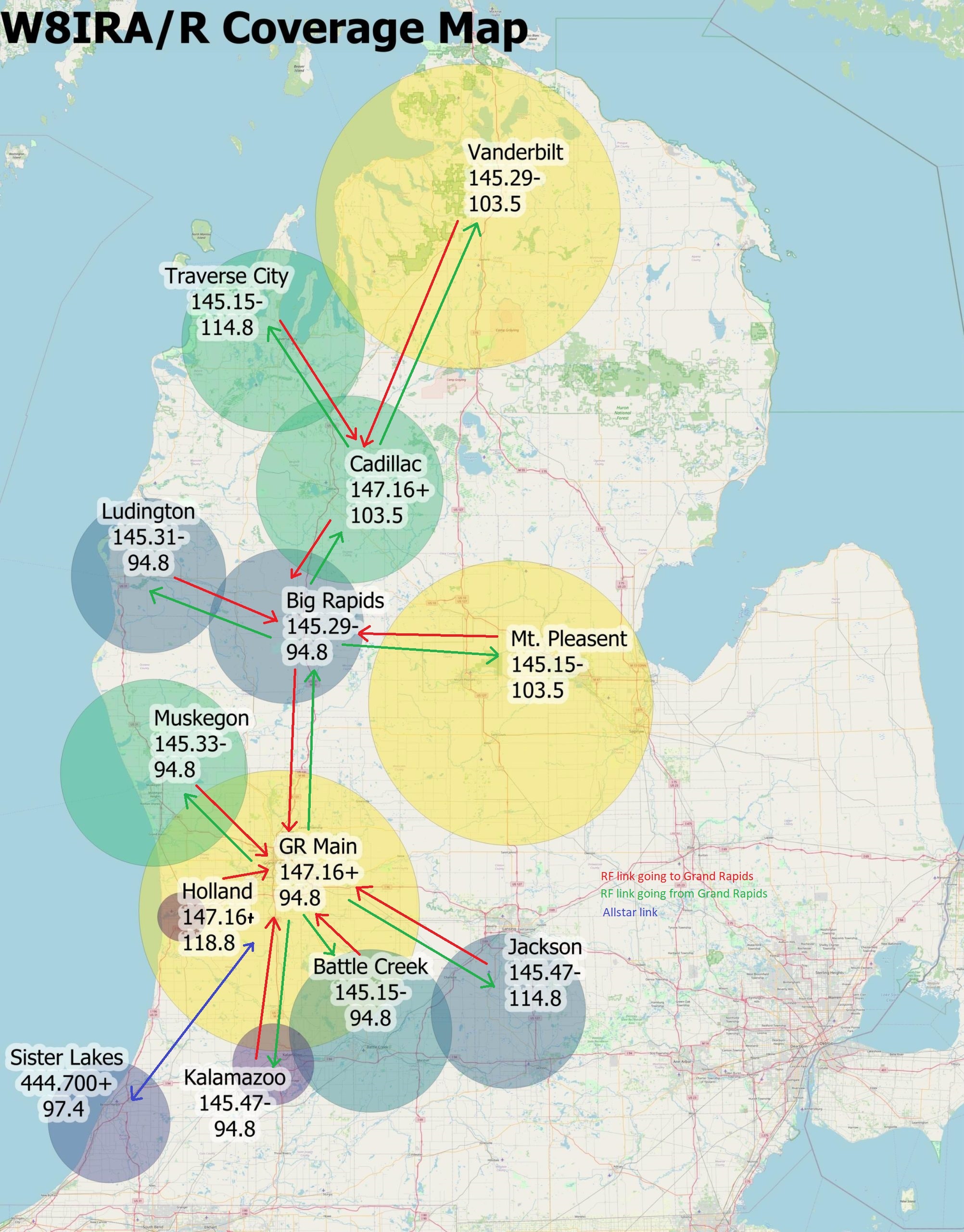
With the practice on HamStudy.org and watching the video series on the harder parts I struggled with, I was able to pass my Technician exam with 33 correct out of 35! You know what that means? Another call-sign. On ham, my call sign is KF8GNZ. Of course, this also meant I had to get some more gear as well! My next purchase was an Anytone 778UVii radio which could operate on the ham frequencies and repeater systems. Michigan has a very rich linked repeater network where I can easily talk to people across the state. Look at this coverage:
This is where things have really gotten interesting for me. I've kept learning new things and finding new ways to do more in the radio hobby. For example, I was able to tune in and hear the International Space Station as it flew overhead. Who knew that functioned as a ham radio repeater? I was able to tune in airport frequencies and can often hear aircraft communicating with our local airport, which is awesome. There's also a fun program called Parks on the Air (POTA for short) where radio operators set up mobile base stations to create a temporary radio community in state/national parks and try to make 10+ new contacts over radio. I think that's awesome, and I'm looking forward to trying it.
Near future goals for me are to make some contacts via satellite. Although I have heard the ISS, and at least 2 other satellites, I haven't been able to have anyone seemingly hear my transmissions so I can't record them as contacts. I'd also like to get some better antennas for longer distance communications. Mid-term goals I'll certainly be looking to get my general certification, and then I'll be able to use the HF frequency bands (and, will have to buy more gear) to open up loner range communication as well.
I'll keep track of some of my gear and efforts on the Amateur radio page here. And, maybe even blog further as I get more interesting things done. For now, I'm still an amateur radio noob and working to keep learning.
But, it's been an awesome new hobby to explore. Thanks for reading!